

In Counter-Strike 2, aim is important. Game sense is important. But neither matters if your team is buying P250s against rifles. The economy is the hidden layer of strategy that separates gold nova masters from the ranks above.
Understanding when to save, when to force, and when to full buy is the fastest way to improve your win rate without firing a single bullet. Here is everything you need to know about the CS2 economy in 2026.
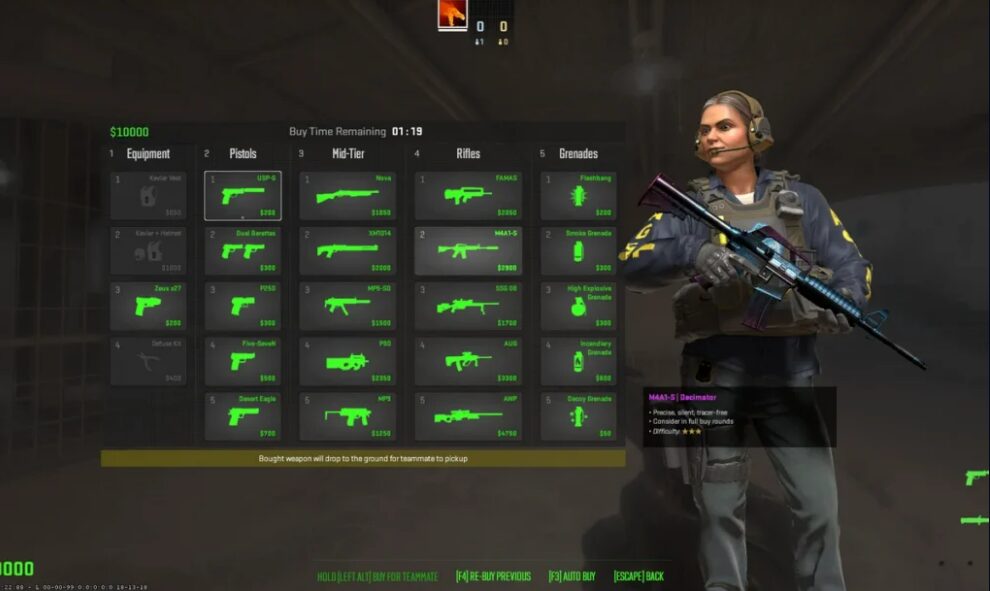
The Core Economy Rules
Every player starts a half with $800. From there, your money depends on kills, round wins, bomb plants, and the dreaded round loss bonus. The loss bonus is the most important number to understand. Lose one round, and your team gets $1,400 each next round. Lose two in a row, and it increases to $1,900. Three losses in a row triggers $2,400, and four or more losses maxes out at $3,000.
This loss bonus system is designed to prevent snowballing. A team on a losing streak eventually gets enough money to full buy and break the streak. Smart teams manipulate this by recognizing when the enemy is on a loss bonus and playing accordingly.
Winning a round resets the loss bonus for the losing team back to $1,400. Bomb plants also matter. Even if you lose the round, planting the bomb gives each player an extra $800, which can mean the difference between a force buy and a save next round.
Full Buy, Force Buy, and Save Rounds
The three core economic states in CS2 are full buy, force buy, and save round. Each has a specific purpose and requires different playstyles.
A full buy means everyone on the team has at least $4,000-$5,000 to spend on rifles, armor, and utility. Full buys happen when you have the money to compete evenly with the enemy. The goal is to win the round and reset their economy.
A force buy happens when you don’t have enough for a full buy but decide to spend anyway. This is usually done when the enemy is also on low money or when a win could break their economy completely. Force buys typically involve SMGs, shotguns, or pistols with armor.
A save round means spending little to no money, usually just a pistol or nothing at all. The goal is to preserve money for a full buy next round. Smart teams coordinate saves so everyone has enough for rifles when the save round ends.
Here is the breakdown of economic states and when to use them:
| Economic State | Money per Player | Typical Loadout | When to Use |
|---|---|---|---|
| Full Buy | $4,000+ | Rifle + Armor + Utility | Even money / Reset enemy |
| Force Buy | $2,000 – $3,500 | SMG/Pistol + Armor | Enemy also low / Break economy |
| Save Round | Under $2,000 | Pistol only / No armor | Preserve for next round |
| Eco Round | Under $1,500 | Default pistol | Full save, maybe sneak plant |
| Anti-Eco | After win | SMGs / Shotguns | Punish enemy save rounds |
The Half-Buy Trap
The worst economic state is the accidental half-buy. This happens when players spend unevenly, leaving some teammates with rifles and others with pistols. A mixed buy almost always loses to a coordinated full buy or even a coordinated force buy.
The rule is simple: buy together or save together. If three teammates buy rifles and two save, the two savers will die instantly, leaving the rifles in 3v5 situations. Just save as a team and full buy next round.
Bomb Plant Economics
The bomb plant bonus is often overlooked but critically important. Planting the bomb gives each player on the Terrorist side an extra $800, regardless of whether they win the round.
This means that even on losing rounds, a bomb plant can set up a force buy next round. Terrorist teams should always prioritize the plant, even when the round is lost. The $800 difference can mean rifles instead of pistols next round.


